Newsletter
April 2026 
President's Report

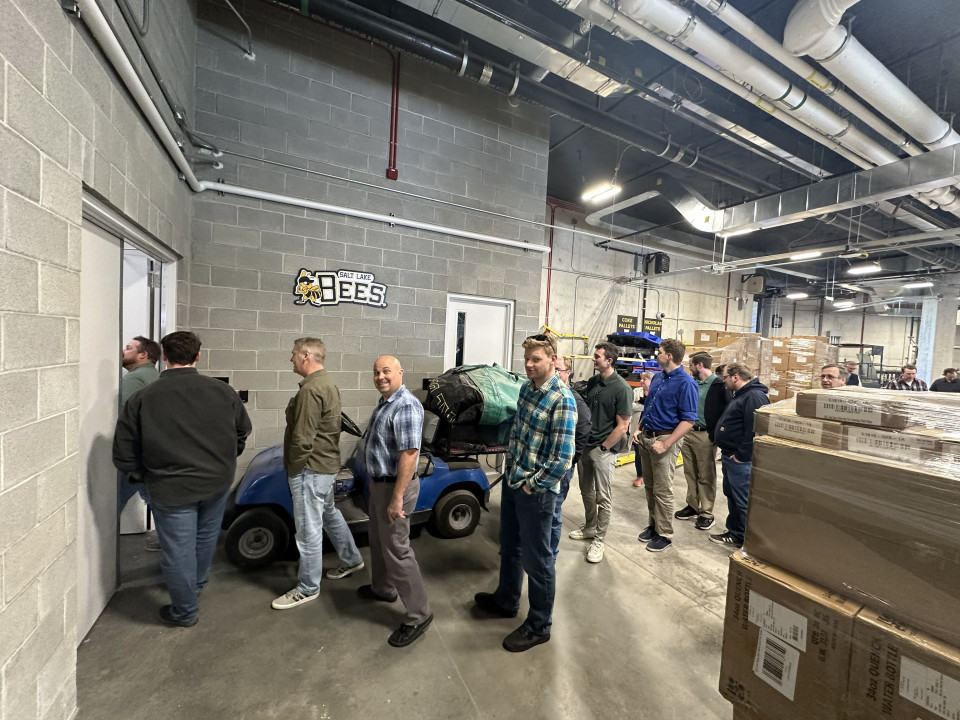
In the last few months we had the opportunity to tour the Bee’s stadium as well as the Weber Basin Water Treatment Plant. Each tour gave us the opportunity to gain an understanding of plumbing systems that no set of plans can fully provide. As plumbing engineers, these visits play a critical role in ensuring systems are practical, efficient, and aligned with real-world conditions.
During the Bee’s stadium site visit, I had the opportunity to invite a couple of co-workers that do not get to do site visits very often. As we walked through mechanical rooms, they started asking several questions and very quickly I noticed that one of the main benefits of a site tour is gaining a clearer understanding of spatial constraints. Mechanical rooms, pipe chases, and ceiling spaces often appear far more generous on drawings than they are in reality. By physically observing these spaces, engineers can better anticipate routing challenges, identify potential clashes, and design systems that are actually buildable. This in turn reduces costly revisions and conflicts during construction.
I appreciate everyone who is able to attend these site tours and encourage you to invite others in your firms to attend as well. If you have any recommendations of building tours we can do in the future, please do not hesitate to reach out to us.
Mauro Artica.
VP Legislative Article

From one person’s perspective.
Why do we have a Plumbing Code and need to follow it? Why do we have rules at all, that we are asked to follow?
We have a code for an understanding of a minimum requirements of what installation work needs to be done for the safety of everyone that comes in contact with these items. I myself want a standard of minimum requirements for my safety and for those around me. I don’t want to get burned because the water is too hot.
Do we always like the code requirements or are we willing to specify the requested equipment. Sometimes no, but if we understand why we are being required to install this equipment then it makes sense. Plus, our job will not be approved until we make the necessary changes that the governing city or jurisdiction requires.
In the long run, it is good for us to follow the code and keep everyone safe. If we don’t like a specific code requirement we can work thru the process of presenting our findings and state why a code item should change. Make a convincing argument and see if that works.
Our job as engineers is to design all our systems so they work correctly and people using them will be safe. So, then we can sleep at night with no worries that we have done our job correctly. We need to have the owner’s best interest in mind and help the job be done correctly and within a good budget.
Our work is important and will be used for a number of years. We are making a vital contribution to the world and we are appreciated for what we do. Keep up the good work.
Have a good day. I often say “Make it a Good Day”.
Sincerely,
Hal Alvord
VP Membership Article

This time of year always seems to spark the same debate: is it time to turn on the sprinklers? Some believe starting early helps prepare landscaping for the stress of summer heat, while others point out that cooler temperatures and recent rainfall are often enough to sustain most vegetation. In the end, it comes down to personal preference—guided by confidence in the health and resilience of what you’re trying to maintain. As professionals, I trust that those of us who work with or alongside engineers have done our homework and can make informed decisions for our homes and families.
There’s a similar consideration when it comes to involvement in ASPE. Membership and participation require both time and financial investment, and each of us must weigh the short- and long-term benefits of engaging with our professional community. From my own experience, while I’ve given up time that could have been spent on project work, I’ve gained valuable insight into different systems, discovered better ways of working, and ultimately become more effective with my time.
Of course, not everyone takes the same approach. I know engineers who prefer to meet their PDH requirements in a last-minute push at the end of the year—and that works for them. Like deciding when to turn on your sprinklers, participating in ASPE is a personal choice that should align with your individual goals. The important thing is to make that choice intentionally.
As you might expect, I’ve chosen to invest in ASPE. And while I’ll neither confirm nor deny whether my sprinklers are already on, I look forward to continuing the conversation—along with many others—at our next meeting.
Affiliate Liaison Article

It might be that I can’t believe the 1st quarter of 2026 is completed. Or that I was feeling a lot of stress, but I did a search and found this:
Mechanical engineering is generally considered a high-stress career, often due to tight deadlines, complex problem-solving, and high-stakes, costly, or safety-critical projects. While some reports suggest moderate stress with high satisfaction, over 77% of professional engineers in one survey reported their work as frequently stressful. Common sources of stress include tight, client-driven deadlines, troubleshooting, and balancing multiple projects. Institution of Mechanical Engineers - IMechE +3
Key Stress Factors
- Tight Deadlines: The need to deliver designs or troubleshoot issues under pressure causes significant stress.
- High-Stakes Responsibility: Errors in design can have significant safety or financial impacts.
- Ambiguity and Complex Problems: Real-world projects often lack clear, structured instructions, requiring engineers to define constraints and solve ambiguous issues.
- Unrealistic Expectations: Some roles require an excessively broad skillset, causing burnout.
- Long Hours: More than one-third of mechanical engineers work more than 40 hours a week. YouTube +3
Stress by Work Environment
- Startups/Small Companies: Often suffer from a lack of resources and engineers acting as the sole, overworked, or overwhelmed staff.
- Large Companies: May lead to feeling "siloed," where work is repetitive and narrow, causing monotony and frustration. YouTube
Impact on Well-being
A significant number of engineers report that stress negatively affects their mental health, sometimes leading to anxiety, poor work-life balance, and physical symptoms. Institution of Mechanical Engineers - IMechE +2
Mitigation and Positive Perspectives
Many find the job rewarding, with opportunities for innovation and high pay offsetting the pressures. Finding a supportive workplace with good management is cited as the best way to manage stress. Reddit +3
An amazing way to mitigate some of the stress is to be a member of ASPE and enjoy our monthly get out of the office and socialize together meetings. See you soon.
Scott